


Aero Escape
3.81.36K Reviews
App Specs
- Version
- 1.4.0
- Updated On
- License
- Free
- Downloads
- 500,000+
- Developer
- Gimica GmbH
- Categories
- Casual
- Platform
- Android
Screenshots



 Analysis by AppCompare
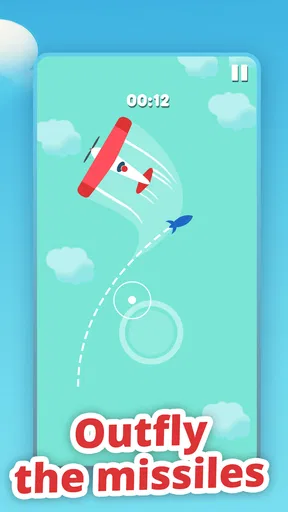
Some casual games are built for a few spare minutes, and Aero Escape fits that role immediately. I found its central idea easy to understand: guide an aircraft through danger, avoid incoming missiles, and grab stars when the route gives me a safe opening. There is no complicated setup to learn, which makes it a natural choice when I want a quick reflex challenge rather than a long session with a story, inventory, or complicated progression system.
That simplicity is both the game’s strongest first impression and the question hanging over it after the novelty fades. Dodging one more missile feels satisfying when I am focused, but a casual game needs more than a clear control idea to remain part of my routine. My experience with Aero Escape is that it works best as a compact test of attention: enjoyable in short bursts, approachable for a wide audience, and less convincing for anyone looking for deep variety or a substantial long-term system.
How Aero Escape feels during the first week
The opening appeal comes from the direct relationship between movement and danger. I do not need to spend time learning a large ruleset before understanding what matters. The aircraft is vulnerable, the missiles create immediate pressure, and stars provide a reason to take calculated risks instead of simply surviving as cautiously as possible. That gives each attempt a small decision to make: should I move toward a reward, or stay in a safer line and protect the run?
I like that the game can be picked up without a tutorial-heavy commitment. It suits the moment when I am waiting for an appointment, taking a short break, or trying to reset my attention after work. The casual classification is appropriate because the game asks for concentration without demanding a long uninterrupted session. A player can understand the basic objective quickly, then spend the next few attempts improving timing and positioning.
The first few days are mainly about learning the rhythm of danger. At the beginning, I tend to react to missiles only when they are already close. With practice, I start watching the available space earlier and thinking about where the aircraft will be a moment later rather than where it is now. That distinction is important. The game is not only testing fast fingers; it also rewards keeping enough room around the aircraft to avoid being forced into a desperate move.
Stars add a useful layer to what could otherwise be a pure survival exercise. I do not treat every star as mandatory. When a star sits near a dangerous route, collecting it can turn a safe attempt into a short one. That trade-off gives me a personal play style: sometimes I prioritize a clean run, while other times I accept more risk because the reward makes the attempt feel purposeful. This is one of the more interesting choices in the game, even though it comes from a very small rule set.
For younger players and anyone who prefers uncomplicated games, the Everyone age rating makes the concept easy to approach. I would still expect a child to need time to develop the same visual anticipation that experienced players use, but the basic objective is readable. There is no need to understand specialized terminology or a complicated fictional setting before playing. That accessibility also makes it suitable for passing between family members, although the appeal will depend heavily on how much each person enjoys repeating short reflex challenges.
Worth Reading Before You Choose

EA SPORTS FC Mobile 26 Is a Bigger Football Game, but It Takes Time

Flipboard Shows What News Apps Must Do Beyond the Feed

Switching to Android Auto Means Rethinking Your Driving Routine

Google Calendar Makes a Crowded Week Easier to Manage

Ludo King Makes the Most of the Minutes Between Plans

Baby Panda World Brings Quick Play to Modern Phones, but Its Game Library Feels Busy
The game is free, which lowers the barrier to trying it during that first week. I can test whether the movement and pacing suit me without treating the download as a serious purchase decision. That matters for this kind of title because the controls and moment-to-moment feel are more important than a feature list. If the aircraft does not respond in a way that feels comfortable to a particular player, no amount of casual convenience will make the game a lasting favorite.
Its early reception suggests that many people have at least found enough value to try it: Aero Escape has passed 500 thousand installs, with an average rating of 3.8 from around 20 thousand ratings. I read that as a mixed but respectable signal rather than a guarantee. It indicates a game with a noticeable audience, while the rating also reminds me that a simple loop will not satisfy everyone equally. Some players will enjoy the clean challenge; others will quickly want more variation than the core idea provides.
The small habits that improve a run
My most useful adjustment was to stop treating stars as the main objective on every attempt. I first focused on collecting anything within reach, but that encouraged abrupt movement and made missile avoidance harder. A better routine is to establish a safe position, observe the next threat, and only then decide whether the star is worth the change in direction. This makes the game feel less frantic and turns each pickup into a deliberate choice.
I also recommend using short sessions rather than trying to force a long personal best when concentration has already dropped. Reflex games can make tired mistakes feel like a control problem when the real issue is attention. A few focused attempts tell me more about my improvement than a long, irritated session. This is a practical advantage for commuters and busy players, because the game can fit into a small break without needing a large block of free time.
Another helpful habit is to notice the space behind and beside the aircraft, not just the missile directly ahead. A narrow escape can leave me in a worse position for the next threat. Thinking about the next safe area instead of celebrating the current dodge makes my decisions calmer. That kind of forward planning is where the game offers more substance than its short description suggests.
What remains useful after the novelty
After the first week, the main question changes from “Can I understand this?” to “Why should I return today?” Aero Escape has recurring value when I want a lightweight concentration exercise. It gives me a clear target for a short break and a simple way to measure whether my reactions and decisions are becoming more controlled. I can imagine keeping it installed for those moments when I want interaction without a story to follow or a large set of daily tasks to maintain.
That value is personal rather than expansive. The game’s lasting appeal comes from refining my own performance, not from discovering a wide world of content. Players who enjoy chasing cleaner runs and testing their reflexes may find enough reason to return. Players who need frequent new environments, characters, missions, or strategic systems will probably feel the loop becoming familiar sooner.
This is where it differs from the usual alternatives in the casual category. A puzzle game may offer a slower, more methodical form of progress, while a match-based title may provide social competition or a stronger sense of changing objectives. Aero Escape is more immediate than those options. I can start playing almost instantly, but I also get less variety in exchange for that convenience. It is closer to a repeatable skill drill than a broad entertainment package.
I would use it differently depending on the situation. During a short waiting period, I would play for concentration and stop after a handful of attempts. At home, I might use it as a transition between tasks, especially when I want something active but not mentally heavy. I would not choose it for a long evening intended to deliver a rich sense of progression. In that setting, a deeper casual game or a title with more changing objectives would likely hold my attention better.
The current version is 1.4.0, and the game supports devices running Android 7.0 or later. That makes it relevant to people using older Android hardware who want a small casual game rather than a demanding modern release. Compatibility alone does not determine how well it will feel on a particular phone, of course, but the stated minimum makes the entry point relatively broad. I would still check the controls on my own device before deciding whether it deserves permanent space.
Because the game is free, keeping it installed has a low financial cost, but storage and attention are still costs. I judge it by whether I actually open it after the first few sessions. If it becomes my default choice for a quick reflex break, it earns that space. If I repeatedly launch it, remember the same pattern, and close it without wanting another attempt, the free price does not make it useful by itself.
Who gets the most month-to-month value?
The best match is someone who likes compact arcade-style challenges and is comfortable creating their own goals. That might mean trying to survive more consistently, collecting stars without taking reckless routes, or simply making fewer panic movements. Aero Escape does not need to become a major hobby to be worthwhile. It can have a small but dependable role in a phone library.
It is less suitable for players who need a strong narrative, a social layer, or a sense that every return will reveal something new. I would also hesitate to recommend it as the only game for someone who quickly tires of repetition. The missile-and-star structure is clear, but clarity can become predictability if the player does not enjoy self-improvement as the main reward.
Maintenance, friction, and the risk of fatigue
Aero Escape has a low maintenance burden in the everyday sense. I do not need to organize a large collection, manage complex builds, or remember a detailed progression plan between sessions. That makes it easy to leave untouched for several days and return without feeling behind. For me, this is a genuine strength: the game does not turn a casual break into another obligation.
There is also a downside to that low commitment. A game with little to maintain can also offer little reason to maintain a habit. The responsibility for creating a return cycle rests mostly with me. I need to decide what I am practicing or why I am opening it, otherwise the same sequence of dodging and collecting can blur into background activity.
The main source of fatigue is repetition. Missile avoidance and star collection create a focused loop, but focus is not the same as variety. If my enjoyment depends on new mechanics appearing regularly, I may reach the limit of the concept quickly. Even a well-designed short challenge can lose its edge when every attempt starts to feel like another version of the previous one.
Another possible friction point is the balance between caution and reward. Stars make the run more interesting, but they can also encourage decisions that feel unfair if I am already under pressure. I found it more satisfying when I accepted that not every star belonged to me. Players who interpret missed rewards as failures may experience more frustration than players who see them as optional opportunities.
Reflex games can also expose differences between players more sharply than slower casual formats. A small improvement in anticipation can feel rewarding, but a player who struggles with timing may feel stuck even when the rules are simple. I would recommend approaching it as a personal practice game rather than expecting immediate mastery. That mindset reduces the temptation to make every attempt a test of worth.
The developer, Gimica GmbH, presents a game whose identity is easy to recognize, and that focused identity is preferable to a cluttered casual experience. At the same time, focus means the title has less room to hide weaknesses. If the controls feel awkward or the challenge does not match my preferred pace, I notice that immediately because there are no unrelated systems to pull me through the rough patch.
For a sustainable routine, I would set a small purpose before opening it: a few careful attempts, a focus on safer positioning, or a session devoted to collecting stars only when the route remains sensible. That prevents automatic play and gives each visit a reason. I would also remove it without hesitation if I found myself opening it from habit and closing it from boredom. A free game should earn attention through use, not occupy a phone indefinitely because it costs nothing.
My long-term verdict on Aero Escape
I see Aero Escape as a competent casual reflex game with a clear place in a specific kind of player’s routine. Its strongest qualities are immediate accessibility, a readable risk-and-reward choice around stars, and the ability to fit naturally into short breaks. I appreciate that I can return after time away without relearning a complicated system. For a quick concentration reset, it does what I want with very little preparation.
Its weakness is equally clear: the core loop may not provide enough changing material for long-term players who expect constant novelty. The game’s lasting value depends on whether I enjoy improving my own decisions. If I do, missiles and stars can remain a compact test of anticipation. If I need new content to create motivation, the initial appeal is likely to fade faster, and another casual game with puzzles, missions, or broader progression would be a better fit.
I would recommend trying it to anyone who wants a free, approachable game for short sessions and enjoys the satisfaction of gradually becoming more composed under pressure. I would especially suggest using the first few days to decide whether the controls feel natural and whether missed stars make me curious to try again rather than annoyed. Those two reactions tell me more than the simple premise does.
For me, the final judgment is measured rather than enthusiastic. Aero Escape earns a place as a lightweight reflex break, not as an all-purpose casual game or a title I would expect to occupy every evening. Its lasting space on my device depends on disciplined use: short sessions, personal goals, and acceptance that survival can matter more than collecting everything. If you enjoy refining a small skill more than unlocking a large amount of content, it is worth keeping nearby; if variety is your main reason to play, the novelty may not last.
Pros
- Fast-paced arcade gameplay is easy to learn but remains challenging.
- Short sessions make it suitable for quick breaks or commutes.
- Responsive controls help you react quickly to incoming obstacles.
- Increasing difficulty keeps later runs exciting and rewarding.
- The minimalist presentation keeps the focus on gameplay.
Cons
- Repeated runs can feel similar after extended play sessions.
- Some players may find the difficulty spike frustrating.
- The game may offer limited variety beyond its core escape mechanic.
- Progress can depend heavily on reflexes rather than strategy.
- Ads or optional purchases may interrupt the experience.
FAQs for Aero Escape
What is Aero Escape, and how does the game work?
Aero Escape is an arcade-style flying game focused on quick reactions, obstacle avoidance, and high-score chasing. You control an aircraft through increasingly challenging environments while trying to stay airborne, collect useful items, and avoid collisions. The controls are generally easy to understand, making it accessible for casual players, although later stages demand accurate timing and consistent concentration.
Is Aero Escape free to download and play?
Aero Escape can generally be downloaded without an upfront purchase, allowing players to try the main gameplay at no initial cost. However, the exact monetization system may vary by platform and version. Some editions may include advertising, optional in-app purchases, or unlockable content. Before downloading, it is worth checking the store listing for current pricing, advertisements, and purchase details.
Does Aero Escape require an internet connection?
The basic flying gameplay in Aero Escape may be playable without a constant internet connection, which is convenient for short sessions while traveling or when mobile data is unavailable. Nevertheless, online access may be needed for advertisements, updates, leaderboard features, cloud-related services, or purchases. Availability of offline features can differ between versions, so users should verify the latest store information.
Is Aero Escape suitable for children and casual players?
Aero Escape is likely to appeal to casual players because its central idea is straightforward and the controls can usually be learned quickly. Even so, the fast pace, repeated crashes, and increasing difficulty may be frustrating for younger children. Parents should review the listed age rating, advertising policy, and in-app purchase settings before allowing unsupervised play.
What devices are compatible with Aero Escape, and how much storage does it need?
Compatibility depends on the specific Android or iOS release and the requirements set by the developer. Most supported devices should be able to run the game if they use a reasonably recent operating system, but older phones or tablets may experience slower performance. Check the official store page for the required OS version, download size, permissions, and available updates before installing.


